

New York State has officially rolled the dice. After years of debate, backroom maneuvering, and enough community board meetings to make a person question their will to live, the state has approved three full-scale, Vegas-style casinos for New York City. Two in Queens. One in the Bronx. And together, they represent somewhere in the neighborhood of $17 to $18 billion in new development.
That is, for the record, a lot of money.
The projects are Metropolitan Park at Citi Field, an expansion of Resorts World NYC at Aqueduct, and Bally’s Bronx at Ferry Point. Each one comes with jobs, tax revenue, hotels, entertainment venues, and a community benefits package that reads like a very ambitious campaign promise. Whether they deliver is the question everybody in Queens and the Bronx should be asking right now.
What’s Actually Getting Built
Let’s take a quick tour of what’s coming to a neighborhood near you.
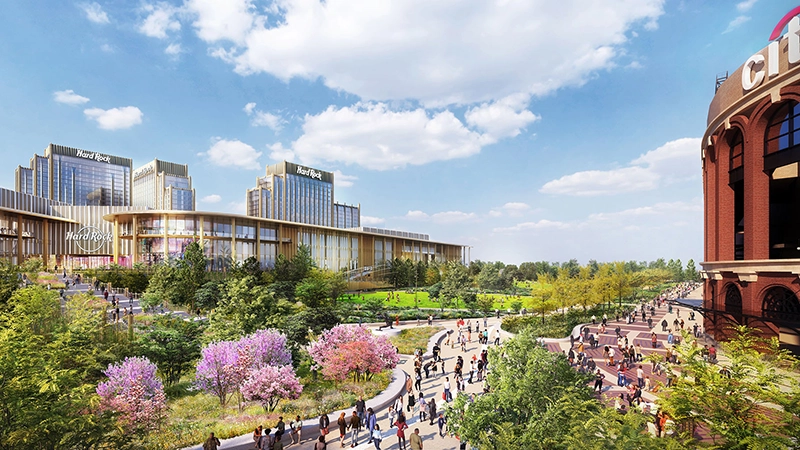
Metropolitan Park is the big flashy one. Backed by Mets owner Steve Cohen and Hard Rock, this $8+ billion complex will sit on the Citi Field parking lot, which, if you’ve ever tried to tailgate there, you know is already a logistical adventure. The plan includes a casino with thousands of slots and table games, a hotel, a performance venue, retail, a food hall called “Taste of Queens,” 25 acres of new public open space, and a rebuilt 7-train station. Steve Cohen buying the Mets and then building a casino next door is the kind of move that makes you think, okay, this guy is playing a completely different game than the rest of us.
Resorts World NYC at Aqueduct is getting a massive expansion that could make it the largest gaming facility in the entire country. The existing racino near JFK is already operating, so this is less of a ground-up project and more of a “go bigger or go home” situation. The expanded version will include thousands of additional gaming positions, a hotel, an entertainment venue, and new green space.
Bally’s Bronx at Ferry Point is being described as the largest private development in Bronx history. At $4 billion, it will include a casino, hotel, event center, nightlife, a spa, food and retail, and upgrades to Ferry Point Park. The site sits at the foot of the Whitestone Bridge, which means it will be very accessible, which means traffic, but we’ll get to that.
The Money, And Who’s Getting It
State consultants project around $7 billion in gaming tax revenue between 2027 and 2036, plus an estimated $5.9 billion in additional state and local taxes over 10 years. Governor Hochul has framed the casinos as a vehicle for funding mass transit and public education, which sounds great on paper.
Here’s the part where I put on my skeptic hat for a second.
Tax revenue generated in Queens and the Bronx does not automatically find its way back to Queens and the Bronx. That money goes to Albany first, then gets distributed through a budget process that is, to put it charitably, not always driven by what’s best for the neighborhoods that created the revenue. Local residents should be paying attention to where those dollars actually land, not just applauding the big numbers in the press release.
On the jobs front, the three casinos are expected to create tens of thousands of positions statewide, with the Queens projects alone projecting more than 11,000 permanent jobs. Both Metropolitan Park and Resorts World are emphasizing unionized positions with benefits, which matters a great deal in neighborhoods where a lot of residents work service and hospitality jobs. A union card with healthcare beats a part-time shift with a smile every single time.
What This Means for Your Neighborhood (And Your Rent)
Large casinos are not just buildings where people lose money to slot machines. They are mixed-use development engines that reshape everything around them, including your apartment, your local diner, and your commute.
Metropolitan Park will likely accelerate redevelopment pressure around Willets Point, Flushing, and Corona. Real estate near a shiny new entertainment district tends to get more expensive, fast. The Resorts World expansion could do the same for Southeast Queens near JFK. Bally’s will bring new energy to a part of the Bronx that hasn’t seen this scale of private investment, possibly ever.
New restaurants, bars, and retail will follow. That part is genuinely exciting. But so will higher rents for residents and commercial tenants, particularly in transit-accessible parts of Queens where the market is already tight. Low-income and immigrant communities in these areas could face real displacement pressure if the city doesn’t pair casino growth with tenant protections and affordable housing investment. History suggests we should not assume that will happen automatically.
On the upside, Metropolitan Park is including 25 acres of public open space and a rebuilt 7-train station, which would benefit daily commuters and local families, not just the gambling crowd. Bally’s has committed to park and transit improvements at Ferry Point. These are real quality-of-life wins if they actually get built as promised.
The Traffic Situation Is Going to Test Everyone’s Patience
Let’s be direct: three major casino complexes in Queens and the Bronx are going to put more cars on roads that are already not handling the current load particularly well.
The Citi Field development and Bally’s Bronx will push additional vehicles onto the Whitestone Expressway, Van Wyck, Grand Central Parkway, and the Whitestone Bridge approaches. On Mets game days combined with a big concert at Metropolitan Park? Pack a snack.
Bally’s has pledged roughly $75 million in traffic and transit improvements around Ferry Point, which tells you something about how significant the congestion impact is expected to be. Seventy-five million dollars is not what you commit to if you’re expecting a mild uptick in local traffic.
The good news is that Metropolitan Park’s 7-train station overhaul could genuinely improve transit capacity and accessibility for everyday riders, not just casino guests. And state officials have linked casino revenues directly to MTA funding. In theory, more gamblers equals a better subway. That sentence would have seemed completely surreal 20 years ago, but here we are.
The Part Nobody Likes to Talk About
Problem gambling is real, and it disproportionately affects working-class communities. Putting two massive casinos in Queens, one of the most diverse and economically varied boroughs in the country, is not without risk.
The state has projected about $10.7 million per year for problem gambling programs tied to the new casinos. Asian American community groups in Queens have raised specific concerns that local residents will bear a disproportionate share of harm, given existing patterns of casino use and the proximity of two sites to densely populated immigrant communities. Those concerns deserve more than a line item in the budget. They deserve outreach, multilingual services, and real partnerships with local health providers.
This is the part of the casino conversation that tends to get buried under the job projections and tax revenue numbers. It shouldn’t be.
The Bottom Line
The casinos are coming. That decision has been made. The question now is whether Queens and the Bronx get the version of this where their communities actually benefit, or the version where they absorb the costs while the upside flows somewhere else.
The community benefits packages are real. Metropolitan Park’s package tops $1 billion. Bally’s committed $625 million. Resorts World has pledged green space, an innovation campus, and local hiring. The State Gaming Commission has approved monitors to oversee whether developers follow through.
But monitors and pledges are only as good as the oversight behind them. Community advocates, local elected officials, and residents need to stay loud, stay organized, and stay skeptical until the concrete is poured, the jobs are filled, and the tax revenue actually shows up in the neighborhood services budget.
New York City has been promised transformative development before. Sometimes it delivers. Sometimes it delivers for someone else.
This time, Queens and the Bronx should make sure they’re the ones at the table.
